
This code is based on the following principles, which must be observed under all circumstances:
There are four basic sanctions that can be imposed against any employee. In order of severity these are:
1.3.1 Verbal warning
In case of a moderate offence, a superior should conduct an informal disciplinary interview with the employee that may result in a verbal reprimand. Written record is kept of this warning and it will be valid for (three) 3 months.
1.3.2 Written warning and final written warning
If verbal warnings fail, management should give the employee a formal written warning. A repetition of wrongful behaviour or a more serious offence can result in a final written warning. A written warning shall be valid for a period of 6 (six) months and a final written warning for 12 (twelve) months, or as otherwise determined by the chairperson. All written warnings will be recorded on a disciplinary form that will be placed on the employee’s file. A copy of the disciplinary form will be handed to the employee.
1.3.3 Dismissal with pay in lieu of notice or summary dismissals.
When, in the employer’s opinion, a series of progressive and or corrective measures have not produced the anticipated effect; or a series of verbal or written reprimands given for minor misconduct have not been effective; or when an employee is alleged to have committed major misconduct, the company should before taking disciplinary action, hold a formal disciplinary inquiry prior to termination of the employees services. In certain instances dismissal without notice will be justified in terms of the company policy and precedent and the principles of the common law. The employee must be informed of the reason for his/ her dismissal in writing.
The disciplinary code must not be seen as an independent document. The applicable provisions of the disciplinary procedure must be adhered to ensure the fair and just application of discipline within the company.
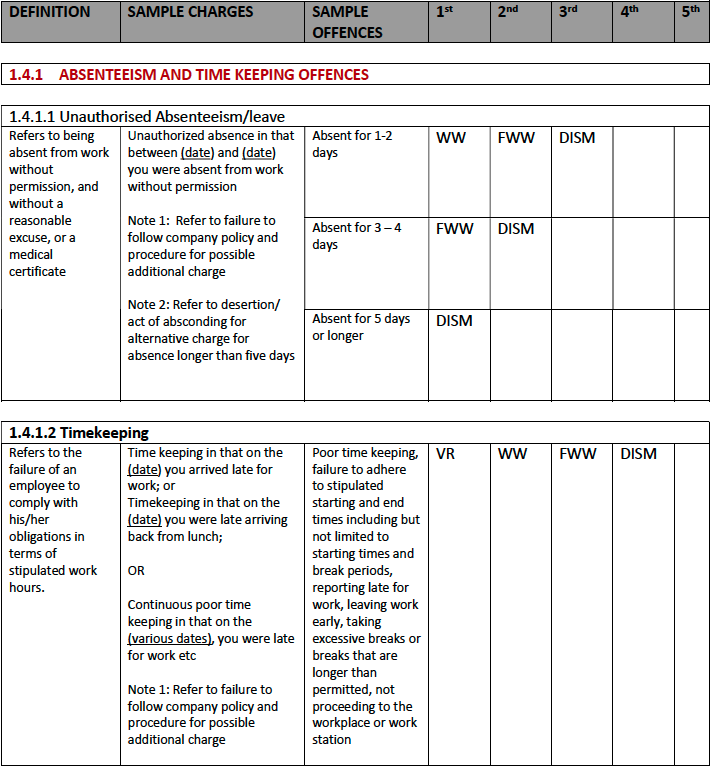
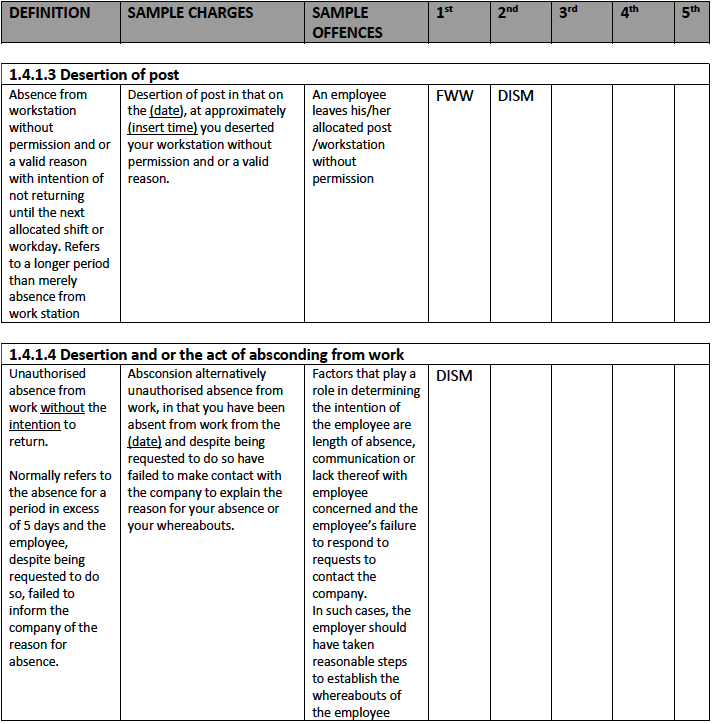
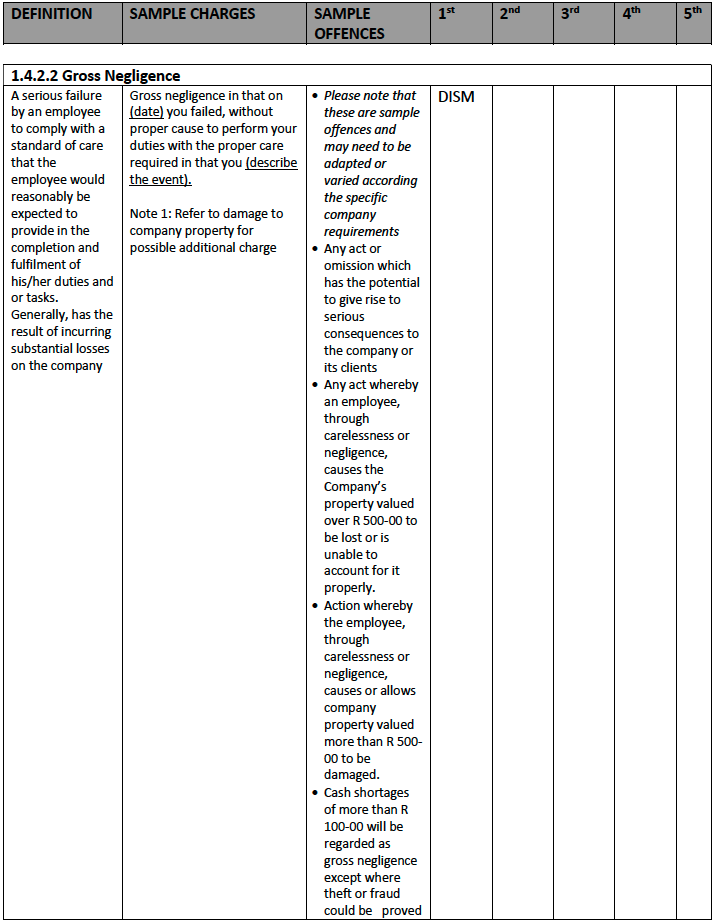
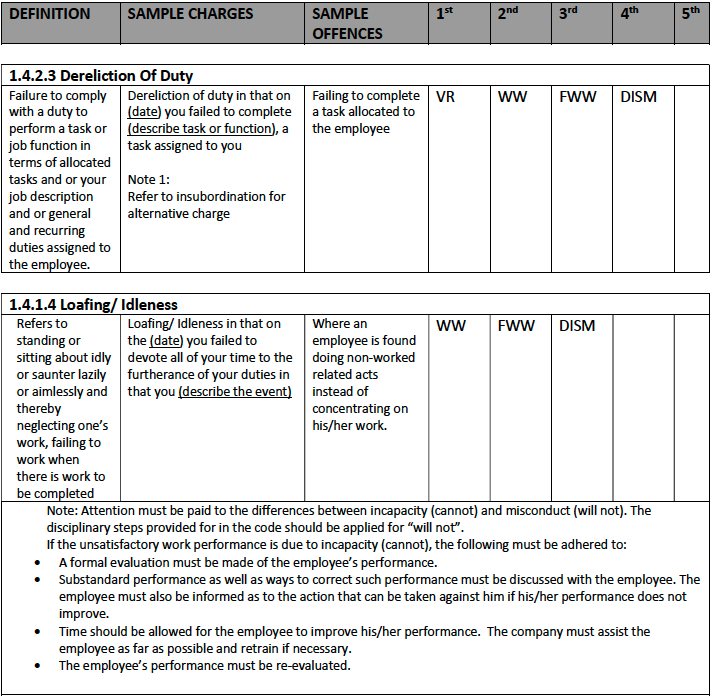
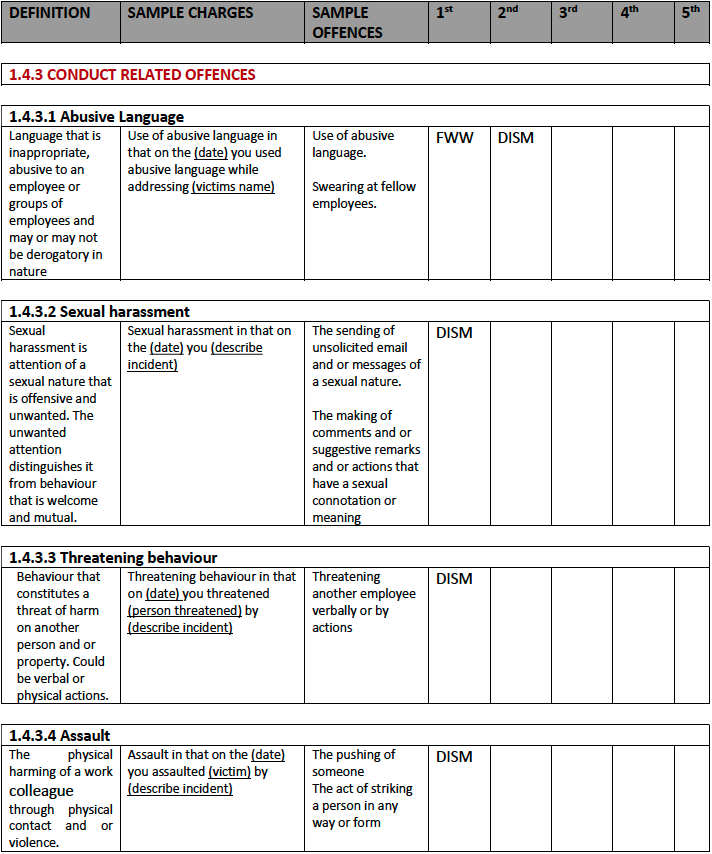
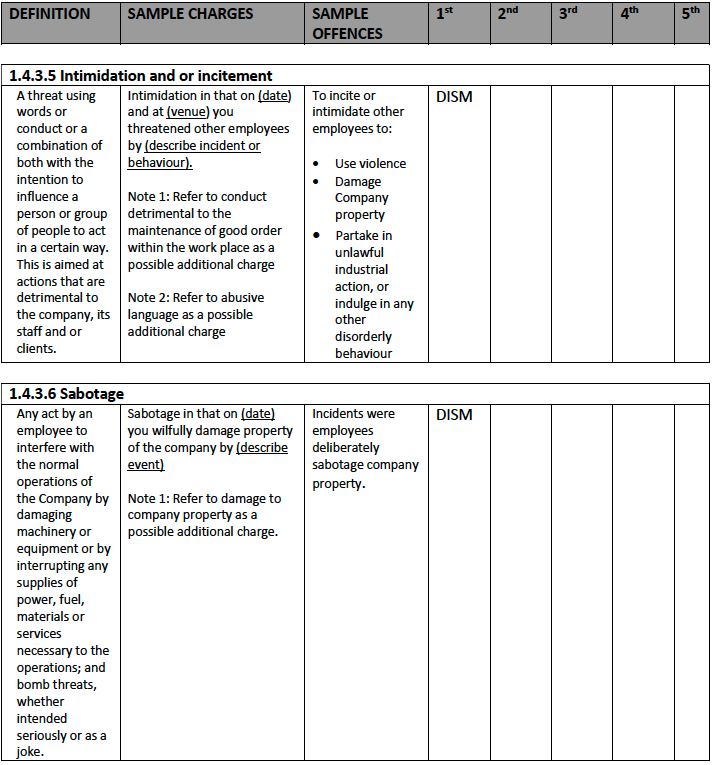
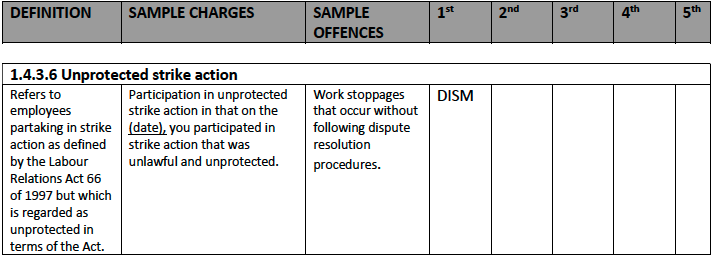
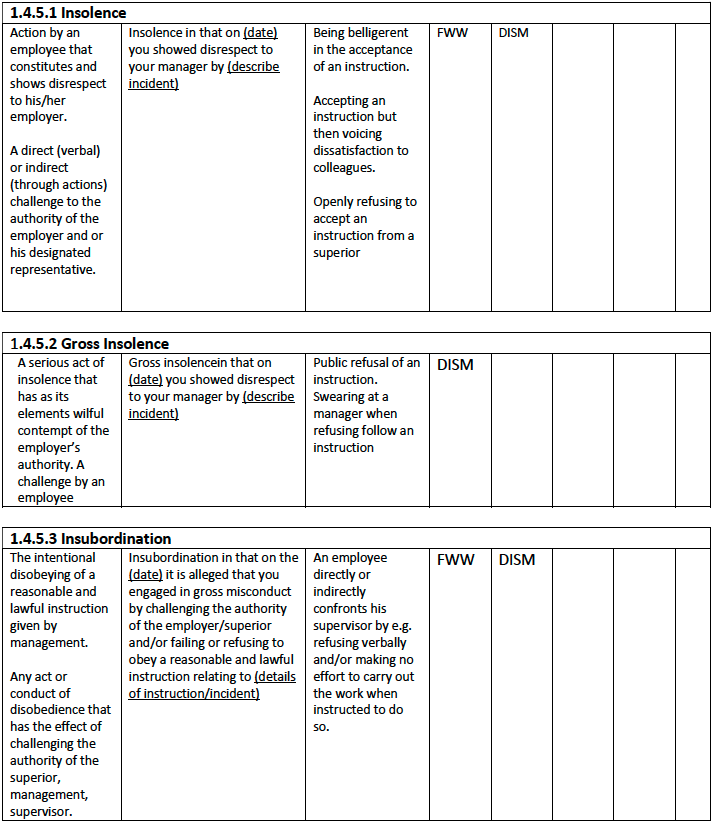
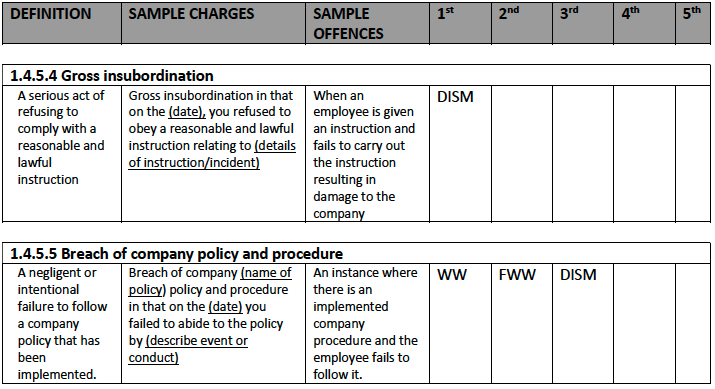
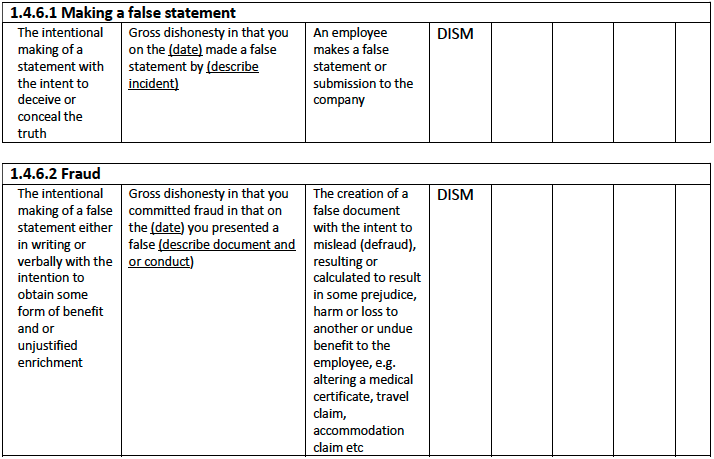
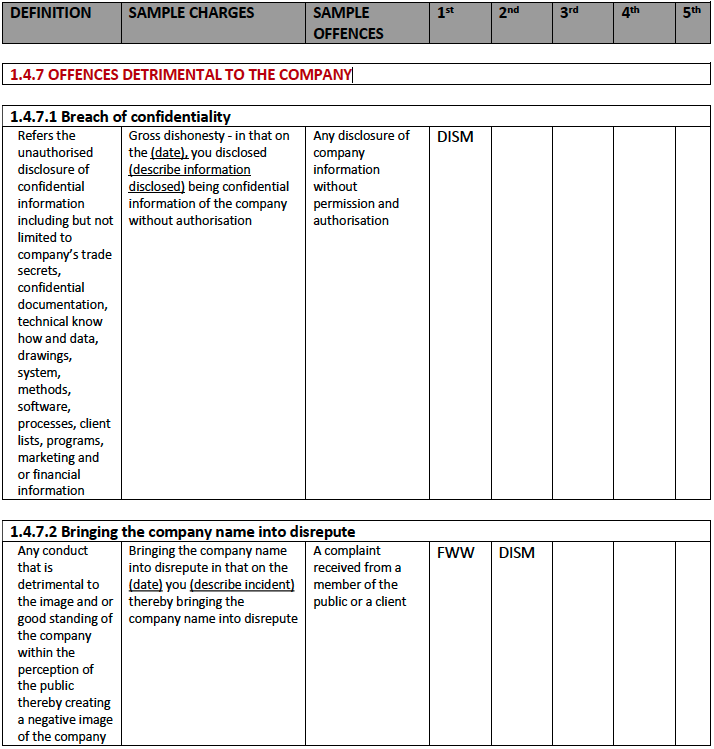
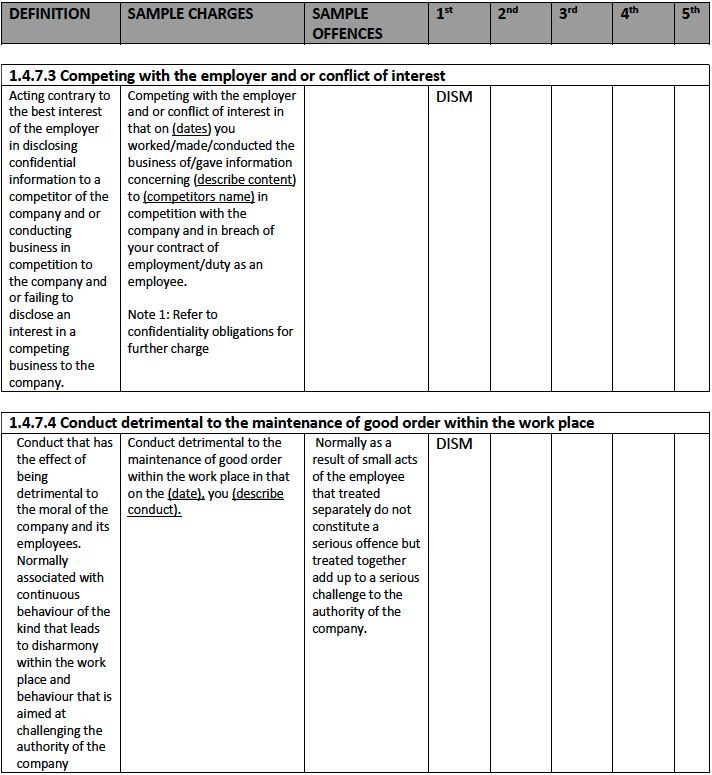
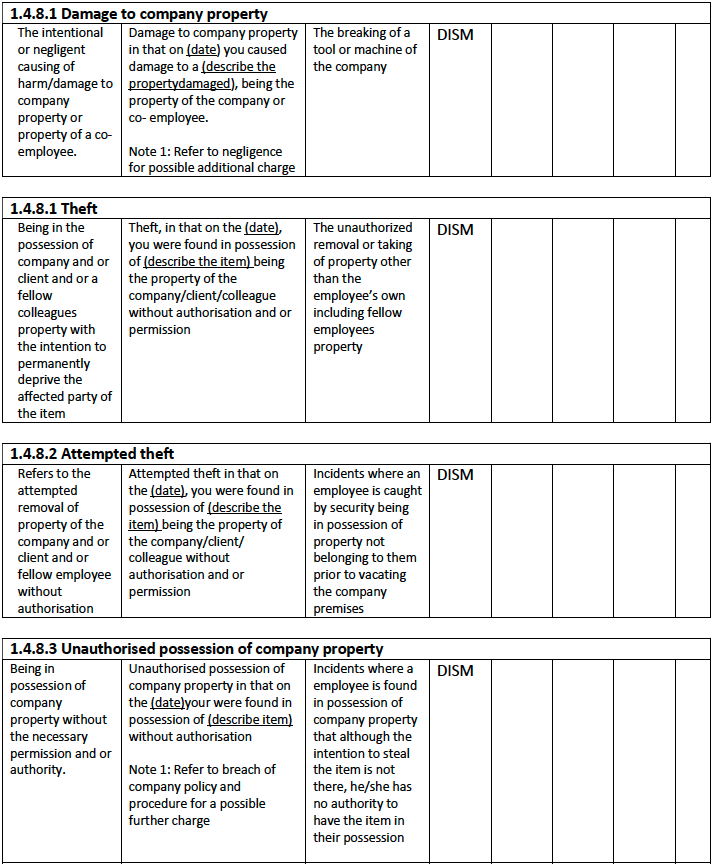
The action as reflected in the columns represents the maximum proposed disciplinary action that may be applied, depending on the nature/type of breach and how many times it has been committed by an employee.
Breaches that are regarded to be related have been grouped into a number of specific categories. In the application of discipline, previous breaches and penalties in a given category, which are still valid, must be considered when deciding what action is to be taken against a related breach (in the same category).
If the chairperson is of the opinion that there are valid mitigating factors, he/she may impose a lesser penalty.
The schedule of offences and proposed action indicated below merely serve as a guideline and do not constitute inflexible rules that have to be followed to the letter. The circumstances and merits of each individual case must be taken into account and the Chairperson is expected to use his/her discretion in making a value judgment. Therefore, deviations from the disciplinary code will be permitted where mitigating and /or aggravating circumstances warrant such deviation.
It is further impossible for the company to list each and every offence that an employee may commit in the work place and therefore the company reserves the right to amend this code and/ or charge an employee with an offence that although not contained within this schedule, is deemed an offence in terms of the common law and acceptable practice.
Word Key
VR – Verbal reprimand
WW – Formal written warning
FWW – Final written warning
DISM – Dismissal


It is generally accepted that the disciplinary code and procedure is aimed at the individual employee. However, in certain circumstances it might be necessary to take action against a group of employees who have breached the company’s rules and regulations that is a collective entity. In this case, the following guidelines are suggested:
A major factor is the witnesses’ previous knowledge of the person being identified as an alleged transgressor; while of less importance are identification marks, facial features or clothing. If a substantial group of employees are involved, the following practice should be adhered to:
It is not required that for every offence a formal disciplinary inquiry be convened prior to deciding on appropriate action. In cases of minor offences an informal inquiry can be conducted prior to imposing a disciplinary sanction. A key aspect of this process is to hear the other side prior to imposing any form of disciplinary action.
However, in the event that a severe offence has been committed or there exists the possibility that should the employee concerned be found guilty, he / she could face severe sanction up to and including a final written warning or dismissal, a disciplinary inquiry should be convened.
In the event that a disciplinary inquiry is convened the following principles should be observed:
1.7.1 The following persons will normally be present at the disciplinary inquiry:
1.7.2 At the commencement of the inquiry the chairperson should read out and explain the misconduct under inquiry. The chairperson should ask the accused if he/she pleads guilty or not guilty. Written minutes should be taken of the inquiry and signed by all parties present.
1.7.3 The employee has the following rights at the inquiry:
1.7.4 After hearing all sides of the case, the chairperson must decide whether the alleged he/she has reached a decision on whether or not the alleged misconduct was committed.
1.7.6 Should the chairperson find that the accused has committed the offence, the chairperson must allow the accused the opportunity to give evidence and to argue either by himself or through his/her representative in mitigation of the disciplinary sanction to be imposed. The company should be given an opportunity to address the chairperson in aggravation of sentence.
1.7.7 After the chairperson was addressed in mitigating by the employee and if the employer forwarded any aggravating circumstances, the chairperson should decide on the appropriate action to be taken and inform the employee thereof. In deciding on a sanction the chairperson should take into consideration the following:
1.7.8 The outcome of the inquiry
The following outcomes may be handed down to the employee after the inquiry:
1.7.10 Right to refer the matter
After the sanction has been handed down the employee must be informed of his/her right to refer the matter to the CCMA or Bargaining Council (if applicable) within 30 days of receipt of the sanction. Please note the company does not allow for an appeal procedure. No appeal will be considered, and the employee is requested to refer the matter to the appropriate body should he/she feel aggrieved by the decision of the chairperson or of the action taken against him/her.
The company reserves the right to amend, add to or adapt any provision of this code. such amendments will however be communicated to all employees.